

Looking for a unique, citrus-forward brew with a fun twist? This Mountain Dew mead recipe combines mild honey with a full bottle of SodaStream Mountain Dew syrup to create a crisp, refreshing 1-gallon batch.
Through multiple trial batches, I’ve found that using a light, high-quality clover honey—specifically Wyandotte County honey from WyCo Woods Apiary—is key. It keeps that distinct, bright Mountain Dew color and lets the citrus shine without being overpowered by darker honey tones. Since local apiary honey like WyCo Woods has limited availability outside the Kansas City area (shoutout to Bacchus & Barleycorn!), any light, mild clover honey will make a great substitute if you’re brewing this elsewhere!
With 2 pounds of honey, this last batch landed at around 12% ABV—which might pack a bit too much of a punch depending on what you’re looking for. If you prefer a lighter session brew, you can easily drop the honey down to 1 pound, which brings the strength into the 7% to 8% ABV range.
Aim for a starting gravity around 1.106 (with 2 lbs of honey), and aim to finish or back-sweeten to 1.010 for the ideal balance of sweetness and soda flavor. Serve cold and carbonated for the ultimate drink!

Mountain Dew Mead Recipe
Equipment
- 1 oz Star San Sanitizer Will make 5 gallons of water to clean everything
- 1 Double Bubble 'S' Type Lock
- 1 5/16" x 7/16" siphon hose 3 to 6 foot
- 1 Hydrometer Optional if checking specific gravity
- 1 10" Hydrometer Test Jar Plastic Optional if checking specific gravity
- 1 2 cup Pyrex measuring cup
- 1 Funnel
- 1 digital scale This helps to know how much honey you are adding.
Materials
- 1 gallon water I use reverse osmosis
- 1 package Red Star Premier Blanc Wine Yeast 5 g packet
- 1 package Red Star Premier Cuvée Wine Yeast 5 g packet
- 1/2 teaspoon Fermaid O I prefer to use Fermaid O but any yeast nutrient should work for mead like this.
- 1/2 teaspoon Pectic Enzyme Powder Not really needed but I use it anyway.
- 2 pound Honey (yields ~1.106 SG / 12% ABV; reduce to 1 lb honey for ~7–8% ABV)
- 1 bottle SodaStream Mountain Dew Syrup
- Allulose This is for back sweeting so it is going to be to taste. I usually start with a 1/4 cup
Instructions
Cleaning Prep
- Clean everything with hot water and Star San. This is to help make sure there are not other yeast or bacteria that is going to effect your mead.
Fermination
- I start by warming 4 cups of water in the microwave. I am trying to get the temperature to between 90 and 98 degrees.
- (I have been told that it does not hurt the honey if the water is below 140 degree Fahrenheit since the honey is going to cool the water down quickly and most of the benefits of raw honey are not lost. But I also know that is not good to let honey get much over 95 degrees Fahrenheit so if you want to make sure you get all of the benefits from the honey you may want to let the water cool to just below body temperature.)
- I pour in the whole bottle of Mountain Dew syrup into the 1 Gallon Glass Carboy using a funnel.
- I then put the glass carboy on the scale and zero it out so that I can pour in 2 pounds of honey.
- Once the temperature of the water is below 98 degrees I can use the warm water to wash all of the honey out of the funnel.
- I then put a lid or something to seal/cover the top of the carboy and shake until all the honey and water is mixed. I want to make sure that the honey isn't settling to the bottom of the carboy and is fully dissolved.
- Add 1/2 teaspoon of Pectic Enzyme powder
- Add 1/2 teaspoon of Fermaid O. (You can stagger the nutrient by splitting it into two additions (1/4 tsp at pitch and 1/4 tsp 2–3 days in) gives the yeast a cleaner burst of energy when competing against high sugars and acidity.)
- Add the packages of Premier Blanc and Premier Cuvée yeast into the carboy.You could just use just Premier Cuvée but I have always used the mix of yeast.I have used the full package or these yeast to make sure that it always ferments. It may not need that much yeast.
- (You can put the yeast into a bowl with few tablespoons of water and wait for the yeast to bloom. This the process of activating yeast in a liquid to ensure it's alive and ready to use. It will start to foam up and bubble if it is ready to use.)
- I then fill the carboy with water until it is a few inches from the top. I have found that just a little above where the carboy tappers in is about right.
- Put the cap back on the carboy and shack until the yeast has been mixed in
- Remove the cap
- Put the bubble airlock into the universal stopper
- Fill the bubble airlock with Star San Sanitizer water or vodka. I normally uses vodka since i have less issue with flies in the vodka then I do in the Star San
Checking Starting Specific Gravity (Optional)
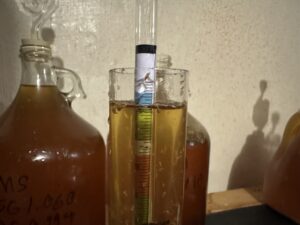
- Fill the Hydrometer test jar between 1/2 and 2/3 full of the mead.
- Lower the hydrometer into the hydrometer test jar slowly and do not drop it in since it can break. If the hydrometer sits on the bottom sits on the bottom add more mead until the hydrometer floats.
- Move to were you eye is at the level of the top of the mead to read the numbers on the hydrometer.

- Record that number on paper you are keeping with the jug or using a permanent marker you can write it directly on the jug. I( usually expect this to be about 1.100)
Let the mead ferment
- I check my mead daily for the first few days to make sure that the bubbler is bubbling and that it had not taken off and overflowed the bubbler.
- Usually between 14 and 28 the mead will stop bubbling and you may see the liquid clearing so that the the lees will fall to the bottom of the jug.
Checking Ending Specific Gravity (Optional)
- Fill the Hydrometer test jar between 1/2 and 2/3 full of mead
- Lower the hydrometer into the hydrometer test jar slowly and do not drop it in since it can break. If the hydrometer sits on the bottom sits on the bottom add more mead until the hydrometer floats.
- Move to were you eye is at the level of the top of the mead to read the numbers on the hydrometer.
- Depending on the dryness or sweetness you want, I go by below 0.999 is dry, 1.000 to 1.009 semi sweet, and over 1.010 is sweet. I have found Mountain Dew is normally 1.040 but the better mead seems to be about 1.010 keeping just enough sweetness but still getting the mountain dew flavor.
Racking
- Using the Auto-siphon to transfer the mead to another 1 gallon container leaving the lees in the bottom of the carboy.
- Clean out the lees and everything left in the carboy
- Transfer the mead back into the clean carboy
- I normally put the air lock back on the carboy and let it sit for a few days to make sure the fermentation does not start back up
Cold Crashing to Clear the mead.
- Once i know that fermentation is finished I move the jug into a refrigerator for a last 24 hour to help clear the mead as much as possible.
- Depending on how much sediment falls to the bottom during the cold crash you may need to rack again.
Back sweeten
- If the mead is too dry you may need to back sweeten to get the flavor you are after. I normally use Allulose since it is not fermentable and then I have the options of carbonating in the bottle or in a Keg.
Leave a Reply
You must be logged in to post a comment.