

For years, my go-to honey ginger cider recipe involved prepping, slicing, or grating fresh whole ginger root. While the flavor was always great, working with fresh ginger root can be messy, unpredictable in strength, and awkward to siphon around.
Recently, I began drinking pure ginger juice mixed with carbonated water and decided to test it directly in the fermenter. By swapping shredded root for pure, 100% ginger juice paired with mild local clover honey, this recipe delivers crisp apple sweetness, smooth honey character, and a clean, sharp ginger bite without the hassle of raw root cleanup.
Here is what you need to know before brewing this batch, along with a key lesson on headspace!
The Ginger Juice Difference
Using pure ginger juice rather than fresh chopped ginger simplifies your brew day significantly. The juice blends instantly with the warmed honey and apple cider, meaning you do not have to wait for alcohol or time to slowly extract flavor from root fibers. Because ginger juice carries quite a punch, 1 cup per gallon delivers a pronounced, warming spice that balances the apple base nicely.
Watch Your Jug Headspace! The most critical adjustment when switching to this recipe is carboy volume. In a standard brown sugar cider, dissolving sugar adds relatively little liquid volume. When you add both 1 cup of honey and 1 full cup of ginger juice, you will quickly overflow a standard 1-gallon glass jug or cider bottle.
- Crucial Step: Pour out at least 2.5 cups of cider before adding your dissolved honey and ginger juice. You can reserve the extra cider in the fridge to top off after primary fermentation settles down.
Gravity & Carbonation Notes
- Starting Gravity (SG): Expect an initial reading right around 1.080, which puts your potential alcohol around 10–11% ABV if fermented completely dry.
- Fermentation: SafAle S-04 ferments cleanly and quickly, typically finishing within 2 to 4 weeks.
- Serving Recommendation: This cider shines when served ice cold and carbonated in a keg or primed bottles, balancing the dry finish with that brisk ginger kick.

Honey Ginger Hard Apple Cider
Equipment
- 1 oz Star San Sanitizer Will make 5 gallons of water to clean everything
- 1 Double Bubble 'S' Type Lock
- 1 5/16" x 7/16" siphon hose 3 to 6 foot
- 1 Hydrometer Optional if checking specific gravity
- 1 10" Hydrometer Test Jar Plastic Optional if checking specific gravity
- 1 2 cup Pyrex measuring cup
- 1 Funnel
Materials
- 1 gallon Cider I normally use Louisburg Cider or Musselman's Apple Cider. Make sure it has something like ingredients apple cider and ascorbic acid. You do not want any preservatives in the cider. You can also use apple juice but cider is better.
- 1 teaspoon Fermentis Safale S-04 yeast This is about 1/4 or a packet
- 1/2 teaspoon Fermaid O I prefer to use Fermaid O but any yeast nutrient should work for cider like this.
- 1/2 teaspoon Pectic Enzyme Powder
- 1 pound Honey
- 1 cup Pure Ginger Juice straight ginger juice without preservatives
Instructions
Cleaning Prep
- Clean everything with hot water and Star San. This is to help make sure there are not other yeast or bacteria that is going to affect your cider.
Fermentation
- Remove two and half (2.5) cups of cider from the jug and put it into another container that can be used to make another batch of cider once you have enough extra cider.
- Remove another cup of cider and warm in the microwave for 1 minute. The warming of the cider makes it easier to mix up the honey and pour it into the jug.
- Fill the measuring cup with honey until it reaches the 2 cup line.
- Mix up the honey and cider so that the honey is dissolved into the cider to make it easier to pour in the jug.
- Using a funnel pour the honey and cider mixture back into the jug.
- Add 1/2 teaspoon of Pectic Enzyme powder
- Add 1/2 teaspoon of Fermaid O
- Add 1 teaspoon of Safale S-04 yeast to the Apple Cider jug.
- (You can put the yeast into a bowl with few tablespoons of cider and wait for the yeast to bloom. This the process of activating yeast in a liquid to ensure it's alive and ready to use. It will start to foam up and bubble if it is ready to use.)
- Put the cap back on the Cider Jug and shake until the yeast has been mixed in
- Remove the cap
- Put the bubble airlock into the universal stopper
- Fill the bubble airlock with Star San Sanitizer water or vodka. I normally use vodka since i have less issue with flies in the vodka than I do in the Star San
Checking Starting Specific Gravity (Optional)
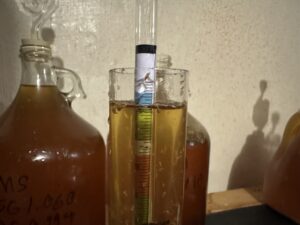
- Fill the Hydrometer test jar between 1/2 and 2/3 full of cider
- Lower the hydrometer into the hydrometer test jar slowly and do not drop it in since it can break. If the hydrometer sits on the bottom add more cider until the hydrometer floats.
- Move to where you eye is at the level of the top of the cider to read the numbers on the hydrometer.

- Record that number on paper you are keeping with the jug or using a permanent marker you can write it directly on the jug. (I usually expect this to be about 1.080)
Let the cider ferment
- I check my cider daily for the first few days to make sure that the bubbler is bubbling and that it had not taken off and overflowed the bubbler.
- Usually between 14 and 28 the cider will stop bubbling and you may see the liquid clearing so that the the lees will fall to the bottom of the jug.
Checking Ending Specific Gravity (Optional)
- Fill the Hydrometer test jar between 1/2 and 2/3 full of cider
- Lower the hydrometer into the hydrometer test jar slowly and do not drop it in since it can break. If the hydrometer sits on the bottom add more cider until the hydrometer floats.
- Move to where you eye is at the level of the top of the cider to read the numbers on the hydrometer.
- Depending on the dryness or sweetness you want, I go by below 0.999 is dry, 1.000 to 1.009 semi sweet, and over 1.010 is sweet. I like my cider below 1.005
Racking
- Using the Easy Siphon to transfer the cider to another 1 gallon container leaving the lees in the bottom of the plastic jug.
- Clean out the lees and everything left in the original plastic jug.
- Transfer the cider back into the clean plastic jug
- I normally put the air lock back on the jug and let it sit for a few days to make sure the fermentation does not start back up
Cold Crashing to Clear the cider.
- Once I know that fermentation is finished I move the jug into a refrigerator for a last 24 hours to help clear the cider as much as possible.
- Depending on how much sediment falls to the bottom during the cold crash you may need to rack again.
Leave a Reply
You must be logged in to post a comment.